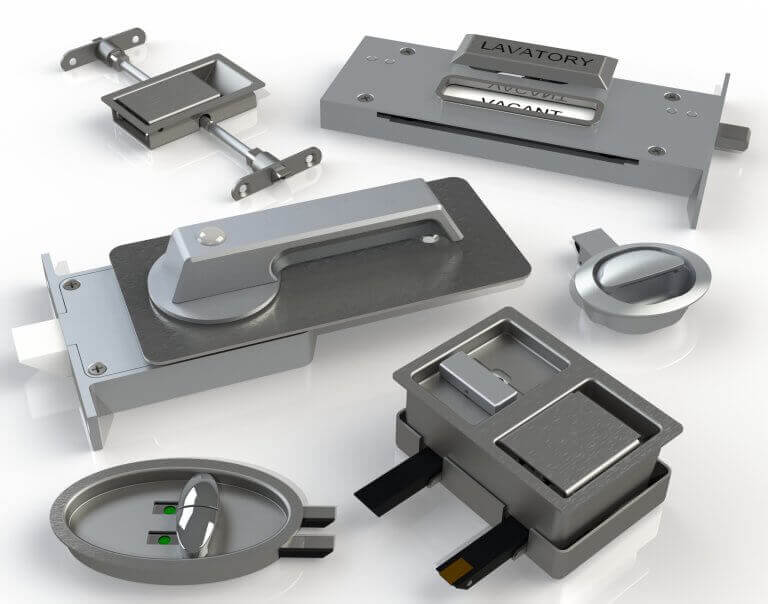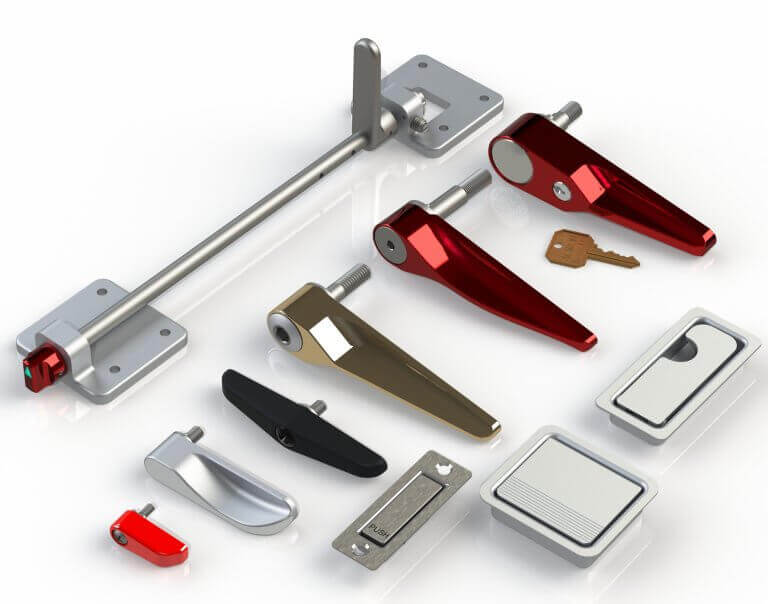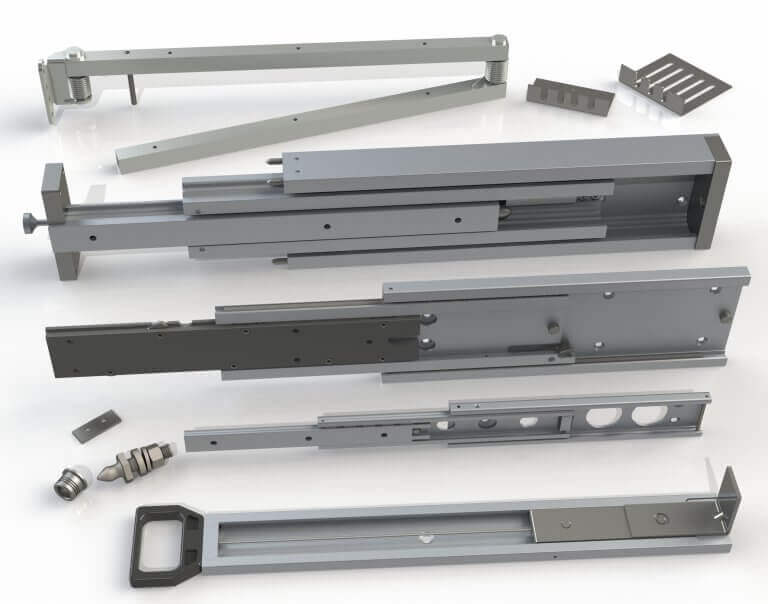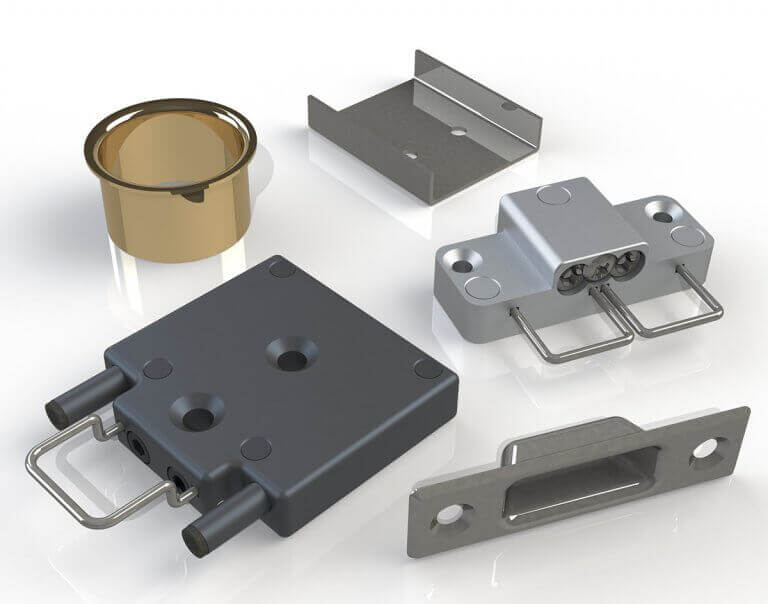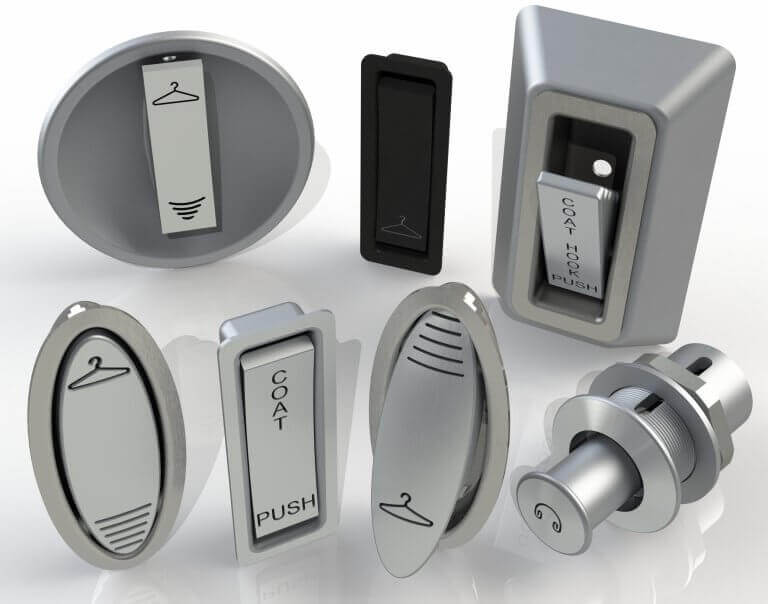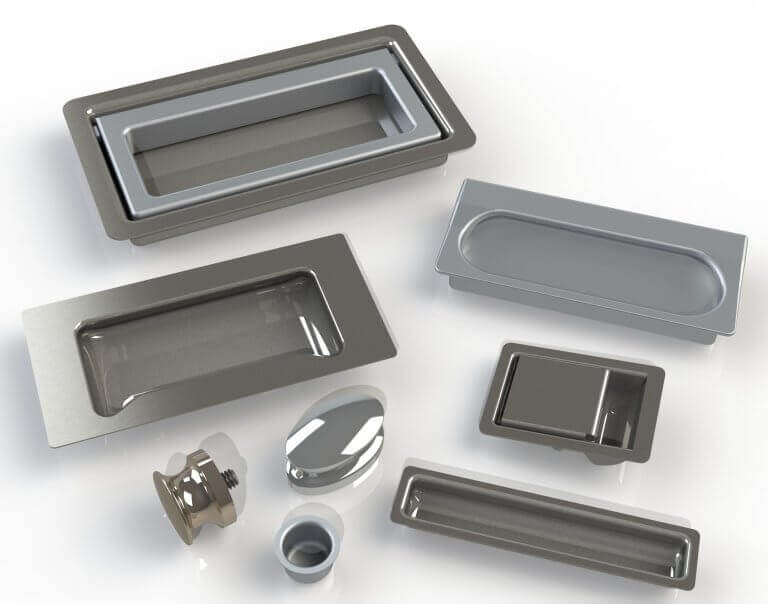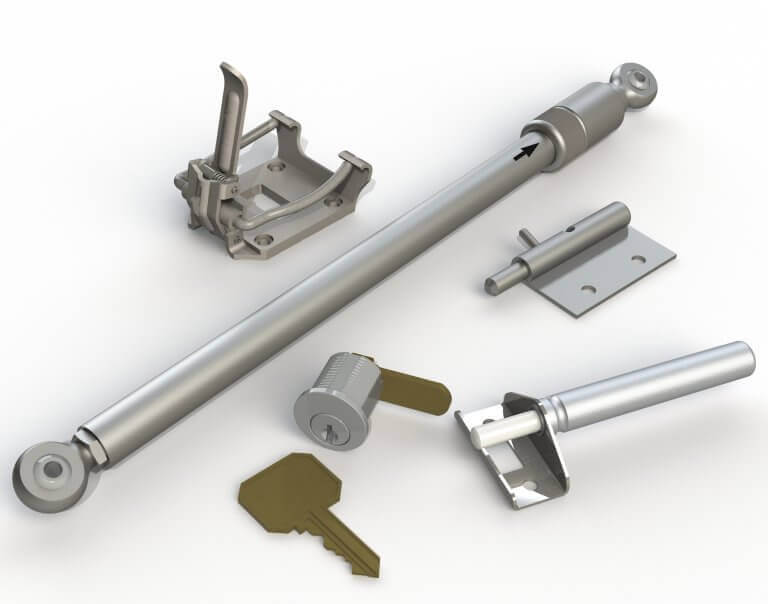

| ACTRAK® Industry standard linear motion slide. AMI ACTRON Manufacturing, Inc. Industry leader in aerospace latching applications. Anodized Finish applied to an aluminum surface that provides a protective coating to retard the natural oxidation tendency of aluminum and protects the surface from scratches. Almost any color is available. Hard anodize color varies between light gray/green to black. Note: Anodize can appear slightly different on different alloys of aluminum. Anti-Friction Latchbolt Latch bolt is equipped with a component to minimize closing force by reducing the friction between the bolt and the strike. Several ACTRON designs exist: - EZ-Close- Low friction plastic inserts installed at critical areas of bolt.
- Touch Close- Trigger release mechanism installed within bolt. Uses special strike.
- Smooth Cam- Cam mechanism exerts a lever action to retract bolt.
Top Backset Distance from the face of a latch to the centerline of its lock cylinder, keyhole, or knob. Ball-bearing slide The basis of the ACTRON telescopic and linear motion technology, a combination of aluminum extruded profiles with precision balls that roll within or without retainers. Bead Blasted Finish See Satin Blasted Finish Bearing Types Full Ball- Free flowing linear motion balls. Roller Ball Bearing- Roller axel rotating on captive balls. Solid Roller Bearing- Roller axel rotating on a solid bearing. Solid Center Track- Solid linear bearing (friction). Stainless Steel Raceways- Option available on some slides to increase slide load, lifecycle and to meet shock and vibration requirements. Bevel Angle provided on the front end of a latch bolt to facilitate its entry into a strike. Typically 45 degrees for slam latches and 60 degrees or blunt for detented latches. Reverse Bevel is available on many latches for doors that swing in the opposite direction. Bolt - Latch bolt: Retractable member that engages the strike. Usually rectangular, hooked, or round in shape with a bevel, hook, full radius, blunt, or bullet nose shaped end. Also called latchbolt. A joggled bolt is formed to accommodate thicker frames. A roller bolt incorporates a roller at the end of the bolt to reduce friction and increase cycle life.
- Retainer bolt: Component used to fasten retainer to cabinet frame. Typically slotted or hex head configuration.
Brackets (Mounting) Used for mounting in *EIA- Retma racks (ordered attached to slide). *Electronic Installation Alliance Types of brackets include: Rear Bracket, Front Bracket. Bright Buffed See polished. Top Cable Carrier Integrated - Slide mounted. Manufactured along with slide assembly (chassis length, width, & travel dimensions are required) Separate - Rack mounted. Ability to add to any installed slide assembly. Cadmium Plated Finish applied to steel that serves as a protective coating against corrosion. Types available in golden or silvery colors. Cam Rotating part attached to the end of a lock cylinder used to engage the locking mechanism. Carrier-plate travel Maximum distance which the carrier plate of a non-extension linear slide covers between the two end positions of the outer slide profile. Case Typically the cupped and flanged member of a latch assembly that houses the handle and supports a bolt guide mechanism. Also called Housing because it houses the lock or latch mechanism. Catch Device that engages a strike and is held in position by means of a ball detent. Magnetic catches are also available. Clear Coated A clear, thin film applied to metal surfaces providing a scratch and corrosion resistant coating. Types can include Epoxy and Urethane. Coat Hook Type of hardware used to support clothing normally hung with a clothes hanger. Typically spring-loaded to a stowed position when not in use. Flush, surface mounted, extending, and pivoting designs from ACTRON are available. Cockpit Door Latch Hardware intended to control access to an aircraft's cockpit. Typically consists of knobs, key locks, and internal slide or rotary lock. Cover Lid covering the housing and latch mechanism. Cutout Suggested installation opening in door or drawer panel(s) to mount latch assembly properly. Cycle The unit derived from one opening and one closing movement of a telescopic slide or linear slide. All ACTRON slides are qualification tested with their load capacity to a minimum of 100,000 cycles. (see Life cycle) Cylinder Cylindrical part of a lock that is operated by a key and contains the tumbler mechanism and keyway. The locking mechanism of a cylinder will only operate when the correct key is inserted and turned. The keyway is the aperture in the cylinder that receives and closely engages the key throughout its length. Tubular type locks operate with special tubular keys. Top Dead Bolt Latch Latch consisting of a bolt with no spring-loaded action or bevel and that once fully extended cannot be retracted except by operating a locking device such as a key cylinder or knob (rotating or sliding). This prevents the latch bolt from unlocking due to excessive vibration or forced entry.Deflection Difference between the loaded and unloaded position of a latch bolt measured at the loading point. Term also used to describe the distance a retainer assembly bends at its mounting point while under load. Deflection Acceptable level difference between a loaded and unloaded slide in its extended position, measured at the front end of the slide with an evenly distributed load. Detented Latch or Retainer Assembly whose locking component is held in position by a ball detent acted upon by a spring. The component will remain in the detent position until the detent force is overcome and it is moved. Detent Device that holds one section of a slide in a given position until an extending or closing force sufficient to overcome or release the detent is applied. In contrast to positive locking. Door Aircraft installation terms: "R" side is the side that is restricted or controlled such as inside the lavatory or cockpit while the "G" side is the general or public access side such as the main cabin. See also Handing of Door for door mounting and swinging terms. Door Bolting System (DBS) A latch assembly consisting of two or more latching points (bolts) operated simultaneously from one central location. Door Hold Open Device to temporarily hold a door in the open position. Typically spring-loaded and flush mounted. Door Opening Device A spring-loaded device used in conjunction with push button latches to spring open the door or drawer. Several designs also incorporate an integral latch strike. Door Pull Flush or protruding handle or grip attached to a door and used to open or close the door by pulling or sliding. Also called Cup Escutcheon. Dynamic load capacity (weight capacity) Maximum load of a vertically mounted pair of slides when extended, using all available mounting positions. The stated load values relate to a minimum 100,000 cycles. A significantly higher load rate is possible with a lower number of cycles. A horizontal installation would considerably reduce the load rate, by up to 75%. ACTRON telescopic slides have a unique "in-line" multiball-track geometry. They are therefore particularly rigid against distortion. This increases durability and dynamic load capacity significantly. Top Edge Plate An angle or channel shaped trim that protects the edge of a door from damage by a latch bolt for example. Electro-polished Chemical finishing process that produces a polished-like surface finish. Escutcheon A protective or ornamental elongated plate with openings for a cylinder, knob, indicator or lever. Sometimes also called a Trim Ring. Extension Distance that a partial or full extension slide covers from the closed to the extended position. Synonymous with travel. Full - Extension equal to 100% of slide length. Partial - Extension of between approximately 75% - 100% of slide length. Increases the standard load carrying capacity of the slide. Over - Extension over 100% of slide length. Decreases the standard load carrying capacity of the slide. Extrator A spring-loaded return device used to pull deeply stowed items to a forward position. Top Finishes, Decorative Provide a decorative chemical surface coating or mechanical surface finish to the highly visible surfaces: See Anodized, Electro-polished, Plated, Polished, Powder Coated, Rubber Coated, Satin Blasted, and Satin Brushed. Finishes, Protective Provide corrosion and/or wear protection to metal surfaces that are generally not visible: See Anodized, Cadmium Plated, Clear Coated, and Passivated. Finishes, Protective Provide corrosion and/or wear protection to metal surfaces. Aluminum - Anodized: Acts as a protective coating to retard the natural oxidation tendency of aluminum. Available in many colors but clear and black are most common on slides. Hard anodize provides additional wear protection with colors varying between light gray/green to black. Note: Anodize can appear slightly different on different alloys of aluminum. Stainless Steel - Passivated: Process that changes the normally chemically active surface of the metal to a much less reactive condition. Also removes surface impurities. Steel Parts - Cadmium Plated: Types available in golden or silvery colors. Flush Latch Latch assembly considered flush to semi-flush with the door panel surface. Flush Bolt Latch installed such that the latch bolt is flush with the face or edge of the door. ACTRON provides many latches with different projections to facilitate mounting in this manner. Top Guide-Bolt Component used to guide and support the bolt. Carries much of the static load by transferring it through the latch bolt to the framework. Top Handle Normally lifted and pivoted to actuate a paddle type latch, slid to actuate a sliding type latch, or lifted and rotated to actuate a rotary style latch. Handles are also used to pull open a door after actuation. ACTRON designs include Lever, D-Ring, Pull, and Cup Pull. Also called flap or paddle when referring to a flush type latch. Handing of Door Indicates what side a door is mounted and the direction it swings. Left Hand Door - Hinged on left; Swings inward Right Hand Door - Hinged on right; Swings inward Left Hand Reverse Door - Hinged on left; Swings outward Right Hand Reverse Door - Hinged on right; Swings outward Handed Hardware Latches or retainers designed to be mounted or operated with doors that swing in a specific direction. Most hardware is non-handed but some handed types are available in opposite configurations to satisfy cosmetic concerns. Hasp - Customs seal - Hasp has one or more openings available for band or wire type seals.
- Padlock - Hasp has hole available for a separate padlock.
- Fixed or hinged - Fixed hasps protrude above the handle surface at all times while hinged hasps can be stowed under the handle when not in use.
Hat Hook Type of hardware used to quickly and securely retain a hat. Typically spring-loaded to a stowed position when not in use. Surface mounted designs are available. Hinge Typically two plates joined together by a pin and fastened to a door and frame allowing the door to rotate. - Invisible or Concealed Hinge - designed such that no parts are exposed when the door is closed.
- Continuous or Piano Hinge - designed to extend the length of the entire moving door or panel.
- Quick Release Hinge - two piece design with a handle to retract and lock back the pin for easy door removal.
Housing See Case Hub Component of a rotating mechanism that is used for support and/or detenting. A spindle or bolt normally passes through it. Also called a base or cam when referring to a Retainer Assembly. Top Indicator Latch Type of latch that has an occupancy indicator displaying the status of a restricted compartment such as a lavatory. Top Joggle Bolt See Bolt Top Keeper Synonymous with Strike Keying Terms - Keyed Alike - All cylinders can be operated from the same key.
- Keyed Different - Individual or groups of cylinders can be operated from the same key.
- Change Key - A key that operates an individual cylinder.
- Master Keyed - All cylinders in a group can be operated from the same key even though each may be operated from a different key.
Knob A protruding handle used for operating a latch or lock. Top Lateral stability Dimension for lateral (side to side) deflection of an extended telescopic slide. Latch Assembly/Components A fastener that can be spring-loaded or detented and used for securing doors and drawers, etc. See Case, Guide-Bolt, Bolt, Mounting Nut, Handle or Knob, Cover. Latchlock Type of latch having an integral keyed lock cylinder to restrict operation. Latch Shapes ACTRON Latches are available in many various cosmetic shapes such as rectangular, stylized, oval, semi-oval, square, and round. Latch Types - Paddle - Type having a flush to semi-flush handle that is lifted and pulled to open a door.
- Sliding - Type having a handle that slides back and forth that typically can also be grasped to open a door.
- Push Button - Type having a button to depress that allows a door to spring open when used with a door opening device.
- Pull Knob - Type having a protruding knob to grasp and pull to open a door.
- Push-Pull - Type having a flush knob in the latched position (dead bolt) and a protruding knob in the unlatched position to grasp and open a door.
- Finger - Type having a round opening to slide latch bolt and pull open a door.
- Hidden - Type mounted inside the cabinet that functions by alternately pressing the door or drawer panel itself to latch and unlatch the door or drawer.
- Hinge latch - Surface mounted and spring-loaded type having a handle to retract the bolt or pin. Some models can retract and also hold back the bolt or pin.
- Hook - Type having a hook engagement onto a pin mounted in a strike or doorframe. Commonly used on sliding doors or panels.
- Lower Latch - Latch with a back mechanism that can be adjusted to suit the application.
- Bin - Type used on overhead bin applications.
- Slam - Type that is spring-loaded and latched automatically when a door or drawer is pushed closed.
- Detent - Type that is detented and must be slid forward to latch and back to unlatch a door or drawer.
- Rotary - Type with a handle that must be lifted and rotated to unlatch and open a door.
- Structural - Type that is generally mounted to the outside structure of an aircraft and is designed more for function than cosmetics.
- Quiet - Type of latches that have specially designed elements that quiet down their operation relative to the standard latch.
- Double Bolt - Type having two independent bolts that are also operated independently in the same housing.
- Two-sided or Double-sided - Type that can be operated from both sides of a door.
Lever Handle or grip used to operate a latch or lock or used to operate or pull a latch. Life cycle Number of movements during the service life of a telescopic slide or linear slide. One opening and one closing movement corresponds to one cycle. Linear Guide See Non-Extension Slide Load - Design Load - Defined as the maximum allowed load on a device before significant permanent deformation or failure occurs.
- G-Load - Gravitational Load applied on a device in service that can be multi-directional.
- Static Load - The design load is applied in only one direction to a stationary and securely mounted device.
- Ultimate Load - Load at which a device has deformed and stopped functioning but has just begun to fracture and come apart.
Load rating Synonym for dynamic load capacity (weight capacity). Lock types Lock-out - Slide locked in the fully extended position. Lock-in - Slide locked in the fully closed or retracted position. Front Panel Release - Exposed device (knob, lever) used to release a slide from the lock-out and/or lock-in position. Captive Screw - Manual release from the lock-in position. Intermediate Lock - Any locking point not occurring at the fully extended or retracted slide position. Lock Bar Assembly Device used to retain door in a closed or stowed position. Assembly is detented in the extended and retracted position. Lock cylinder See also Cylinder, Keying, and Tumbler. Cylindrical mechanism that provides a locking function and is operated by a key. Composed of outer shell, inner plug with keyway, pin tumblers, key, and cam. Lazy cam design rotates cam 90 degrees while the key rotates 360 degrees allowing the key to be removed in both the locked and unlocked positions. Key retaining is a term used for a lock cylinder whereby the key cannot be removed until the cylinder is rotated to a specific position only. Life cycle Number of movements during the service life of a latch or retainer assembly. One opening and one closing movement corresponds to one cycle for a latch. A retainer completes one cycle by rotating either 90 degrees left or right and then back again. Lubrication The moving components of latches and retainers are typically coated with one or more of the following: dry film lube, heat cured Teflon coating, oil based grease, or Teflon grease. Top Materials Slides are generally manufactured using high strength aluminum alloys with components or features being either stainless steel or aluminum. Latches and retainers are generally manufactured using stainless steel and high strength aluminum alloys. They are selected for their strength, durability, corrosion, and finishing properties. Mortise Cavity created for installation of a lock or latch assembly fully into the door frame such that the lock or latch face is flush with the edge of the door. A half-mortise installation places the lock or latch flush with the door edge and a door surface. Mounting Plate Plate or bracket used to mount a latch to the door or drawer from the inside. Standard mounting plates are available for many latches. Mounting Nut or Insert The fastener installed in a latch assembly and used to secure it to a door or drawer in conjunction with a screw. These fasteners can be specified to be free running or self-locking and a locking compound can be applied to their internal threads. Top Non-Extension Slide Linear motion track operating back and forth within a stationary channel. Used for light load or positioning applications. Nut Bar Plate used to fasten slide mounting brackets or cable carriers to *EIA-Retma racks. *Electronic Installation Alliance. Top Offset Clearance between the underside of a retainer assembly and its mounting surface. Top Passivated Term for a process performed on stainless steel that changes the normally chemically active surface of the metal to a much less reactive condition. Removes surface impurities and enhances corrosion resistance. Plated General term for a group of metal surface processes that can provide corrosion resistance and/or enhance the decorative appearance of an item. Some examples include Chrome, Gold, Nickel, and Silver plating. Many standard and non-standard finishes are available. Polished Process of providing a lustrous or mirror-like finish on metal by using fine abrasive particles on a machine powered soft fabric wheel. Positive locking Mechanical locking of an extended or closed telescopic slide. The lock can be released by actuating the locking mechanism, either by hand or mechanically. Positive stop Synonym for stop. Powder Coated Painting process that uses a precise electro-static technique to apply the paint. Varying thicknesses, durability, and colors are available. Privacy Lock Lock operated by a lever or knob as opposed to a keyed lock cylinder. Typically used on the inside of a two-sided latch. Applications include lavatories and changing rooms. Projection Refers to the distance the bolt extends from the latch at full extension. Dimension is normally given from the formed case body to the end of the bolt. Top Quick Disconnect Special function which enables one slide profile to be detached, or released from the remaining component by depressing a release trigger. Quick Release Mechanism A mechanism that needs only hand or finger operation without the use of any special tools. Top Retainer Bar component of a retainer assembly that is rotated into position by hand. Also referred to as a Turn. Retainer Assembly/Components Cam action fastener used to block a door, drawer, container, or trolley from opening or moving from its stowed position. Also referred to as secondary latching and a 1/4 Turn Retainer Assembly. See Retainer, Hub, Bolt. Retainer Assembly Types/Terms - Detented - Retainer or turn is held in a rotary position by a ball detent until purposely moved to another position by the user. These positions can typically be at one or more of the following positions: 45o, 60o, 90o, 180o, or 360o both left and right rotating and with or without hard stops.
- Spring-loaded - Retainer or turn always returns to its sprung-loaded resting position once the operator releases it from its rotated position.
- Rectangular - Basic standard shape of the retainer bar.
- Tapered - A cosmetic effect that gradually reduces the width of the retainer bar along its entire length for appearance and weight reduction.
- Sculptured - A cosmetic effect on the retainer bar to enhance appearance and reduce weight.
- Single - Retainer bar has one side to block door, trolley, etc. Most common.
- Double, Triple - Retainer bar has multiple sides to block door, trolley, etc.
- Remote - Retainers designed for blocking internal items and remotely operated by a knob or forward retainer attached to the frame.
Rod Component that ties together the latch and remote bolts particularly in a door bolting system. Roller Bolt See Bolt Rubber Coated Coating applied to latches or retainers to provide a measure of heat insulation. Available in several colors and thicknesses. Top Safety Factor Typically a 25% allowable safety factor on given slide loads. Safety Indicator An indicator that displays the latched condition of a device. Examples include rectangular latches with red and green dots and paddle latches that have spring loaded out handles. An indicator warns the user when the latch bolt is not fully projected and provides the user evidence when it is. Satin Brushed or Buffed Metal surface finish produced by line graining with sandpaper followed by buffing with a fine abrasive compound. Satin or Satin Blasted Finish Decorative finish created by bead blasting the metal surface. Sequencing Device Slide component that controls the extension sequence of individual track members during slide operation. Shaft See spindle. Slide Synonym for ball-bearing slide, telescopic slide, linear slide, rail, glide. Slides typically have three channels but are available with up to four channels depending on the slide series selected. Cabinet Track - Outer most member mounted to cabinet. Also called Outer Track. Middle Track - Central member carrying most of the load. Also called Intermediate Track. Drawer Track - Innermost member mounted to chassis on three section slides that can also be disconnected. Also referred to as Chassis Section. Supporting member to Drawer Mount Track on four section slides. Drawer Mount Track - Innermost member mounted to chassis on four section slides. Used in conjunction with Drawer Track as a disconnect member. Slide Travel Synonym for Extension. Slide Types/Options Quick Disconnect - Mechanism to easily remove the chassis from the cabinet or rack. Quick Disconnect with Pivoting - Mechanism that provides easy access to the rear of the chassis either by removing or Pivoting + 90 degress after full extension. Full Ball - All ball raceways. Shock Block - Block device added to slide assemblies to increase their shock & vibration capacities in the closed or retracted position. Shock Pin - Mating pins used in conjunction with Shock Blocks. Shock Block, Adjustable - Inter-Locking SST Receptacle Nut used to support Chassis Section in the closed position. Mounting Shelf - Extruded angle used to "Bottom Mount" Chassis. Mounting Flanges - Mounting area used when conventional Outer Channel mounting holes are not accessible. Spindle The central shaft or bar that is used to operate a latch or lock mechanism and is typically connected to a handle, knob, or lever. Spring-Loaded Latch or Retainer Assembly whose locking component is under constant spring pressure. If moved, it will immediately return to it resting position once the force is removed. Standoff See Mounting Nut or Insert Stop Any component mounted to the individual slide members that restricts travel between members and prevents them from separating from each other. Stops are typically pins. Strike Metal plate that is fastened to the doorjamb and is pierced or recessed to receive the latchbolt. It can also protect the doorjamb from damage. The lip of a strike is the projecting part on which the latch bolt strikes and rides. Wire types also exist for low load applications. Also called a keeper. Strut - Telescoping - Type that can hold a door or panel open at one or more selected positions. It is typically released from its locked position by sliding or rotating a knurled knob. Struts are available with different tension and compression loads. Also called Door Holder.
- Fixed - Type that has a specific fixed length with minimal adjustment and rated for high tension and compression loads.
Top Telescopic slide Synonym for slide, ball-bearing slide. Generic term for partial and full extension slides. Travel See Extension or Slide Travel Thumb Turn Small handle or lever incorporated in a doorknob or latch housing used to operate the locking function. Travel The total distance the latch bolt moves between the fully extended position and its retracted position after operation. Also called Throw. Trim Ring Matching decorative component affixed to a door or drawer panel and used to hide installation cutout marks. Sometimes also called an escutcheon or sleeve trim. Tumbler Lock cylinder term referring to the type of internal mechanism. - Pin-tumbler type locks are constructed of solid brass and incorporate small sliding pins against coil springs for maximum durability, security, and key changeability.
- Disc-tumbler type locks are constructed of die cast zinc and incorporate wafers for commercial locking applications.
- Solid-tumbler type locks offer low profile but with single keying and minimum security.
Top |